There is no magic green spray. When a pest control company says “environmentally friendly,” the words should mean something specific: a working method, Integrated Pest Management, that uses less material, placed more precisely, and only where the evidence says it’s needed. When the phrase means anything less than that, it’s marketing.
Here is what the method actually involves, why it genuinely works better for most household pests, and, just as important, what it can’t do.
Key Takeaways
- Environmentally friendly pest control is a method, not a special product: inspect, identify, fix conditions, then treat only where needed
- Targeted baiting uses a fraction of the material of broadcast spraying and works through the colony instead of just the pests you can see
- Placement discipline is what protects kids, pets, Tampa Bay waterways, and pollinators
- In-wall pest tubing delivers treatment inside wall voids: no drilling, and nothing applied in your living space
- Eco friendly does not mean treatment free, and you should expect to be told when a product application is necessary
What Does “Environmentally Friendly Pest Control” Actually Mean?
It means Integrated Pest Management (IPM), the approach University of Florida’s IFAS extension has promoted for decades as the standard for responsible pest control. IPM is a sequence, and the order is the whole point:
- Inspect before anything else. Find the pest, the entry points, and the conditions feeding the problem.
- Identify the exact species, because the right response differs pest by pest.
- Exclude and correct: seal the gaps, fix the moisture, remove the food source.
- Treat, last and least: targeted applications only where activity was actually found.
Compare that to the old model: a technician sprays every baseboard in the house on a monthly schedule whether pests are present or not. The environmental benefit of IPM isn’t a gentler ingredient. It’s dramatically less material overall, placed where pests actually live instead of where people do.
What Does IPM Look Like on an Actual Service Visit?
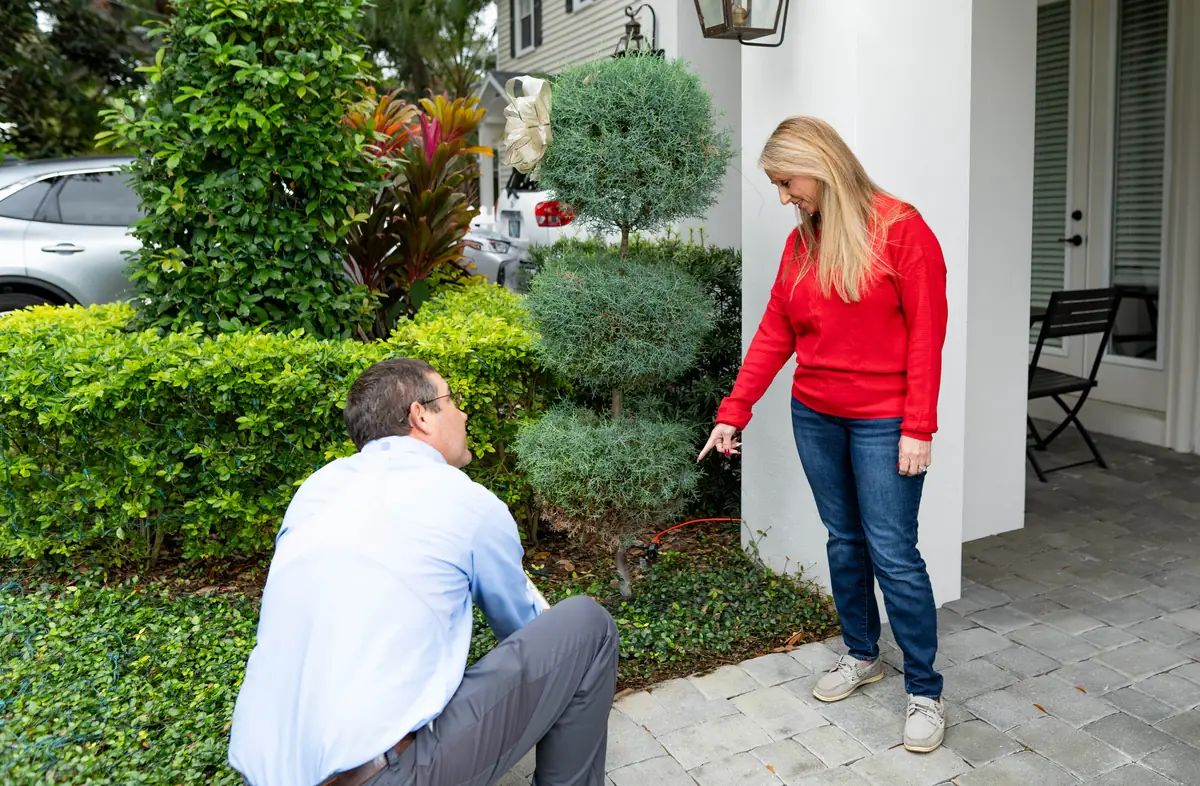
Here’s how the sequence translates into what a technician does at your home.
| IPM step | What it looks like on a visit |
|---|---|
| Inspection | Walking the exterior and interior looking for moisture, entry gaps, droppings, trails, and harborage before touching any equipment |
| Identification | Naming the actual species: ghost ants and carpenter ants call for completely different responses |
| Exclusion and sanitation | Flagging the gaps to seal and the conditions to fix: the leaking hose bib, the mulch against the slab, the pet food left out |
| Targeted treatment | Bait placements in cracks and voids, exterior perimeter work, direct mound treatment, only where activity was found |
| Monitoring and follow up | Comparing activity to the last visit so the next treatment targets what the property is actually doing |
Notice how much of that list involves no product at all. In Tampa Bay, a large share of pest problems are really moisture problems first. Our guide on moisture and pest problems explains why fixing a damp crawl space or a clogged gutter often does more than any treatment could.
Why Does Targeted Baiting Beat Broadcast Spraying?
Two reasons: baiting eliminates the colony, and it uses far less material doing it.
With colony insects like ants and roaches, the pests you see are foragers. Most of the colony, including the queens, never leaves the nest. Spray the trail on your counter and you’ve killed the workers you could already see while the colony keeps producing more. A bait works the opposite way: foragers carry it back and share it through the nest, which is how the treatment reaches the queens you’ll never lay eyes on.
There’s a second problem with spraying that Florida homeowners learn the hard way. Some of the ant species most common in Tampa Bay kitchens respond to repellent sprays by splitting the colony: one nest becomes several, and the infestation you tried to kill has now multiplied. It’s one of the main reasons DIY spraying so often makes ant problems worse instead of better.
And the material math is simple. A bait placement is a dab in a crack. Broadcast treatment is gallons of diluted product across a lawn or every baseboard in a house. Less applied means less to run off, less to track, and less for anything other than the target pest to encounter.
The honest trade-off: baiting takes days, not minutes. You may see trails continue for a short while as the bait moves through the colony. It’s slower to look impressive, and far more likely to actually finish the job.
How Do You Protect Kids, Pets, Waterways, and Pollinators?
Mostly through placement discipline, which costs nothing but care.
- Exterior first, interior only where pests are active. Most of the work happens at the perimeter, where pests are coming from.
- Crack and void placements indoors. Treatment goes where pests travel (behind the cabinet kick plate, inside the wall void), not on open floors where hands and paws go.
- Respect dry times. Kids and pets stay off treated areas until they’re dry; your technician tells you exactly how long.
- Keep material out of the water path. Storm drains in Tampa Bay neighborhoods carry runoff to ponds, creeks, and ultimately the bay, largely untreated. That means no applications on driveways and sidewalks that drain to the street, and no applications ahead of heavy rain, a real constraint in a Florida summer, and one worth asking any company how they handle. In communities built around stormwater ponds, like much of Westchase, the yard and the waterway are effectively connected.
- Protect pollinators. Blooming plants that bees are working don’t get treated, period. Targeted mound and void treatments exist precisely so a flowering landscape never has to be blanketed.
How Does In-Wall Pest Tubing Keep Treatment Out of Living Spaces?
Many newer Tampa Bay homes were built with a network of perforated tubing inside the wall voids, connected to a small service port on the exterior. In-wall pest tubing lets a technician deliver treatment directly inside the walls (the exact spaces where roaches, ants, and silverfish harbor) without drilling, without moving furniture, and without applying anything inside your living space at all.
It’s about as low exposure as treatment delivery gets: the material stays inside the wall, and the technician never has to enter the home to do it. If your home is newer construction, check the exterior walls for a small labeled port. Plenty of homeowners have the system and don’t know it.
What Can’t Environmentally Friendly Pest Control Do?
This is where greenwashing usually starts, so let’s be direct.
It is not treatment free. An established German cockroach infestation will not be solved by sanitation and sealed cracks alone. It requires targeted product placements, applied carefully and repeatedly. Any company promising to eliminate an active infestation with no treatment at all is overpromising.
It is not instant. Baiting and exclusion work over days and weeks, not on contact. If you want a colony gone rather than temporarily invisible, that’s the timeline.
It is not permanent without maintenance. Florida’s heat, humidity, and rain keep pest pressure high all year. There is no season when the pressure stops, only seasons when it shifts, as our guide on how weather changes affect Florida pest activity lays out. Skipping monitoring means starting over.
It doesn’t cover everything. We’ll name our own limit here: Liberty doesn’t offer termite services at all. Termite work is its own specialty, and when an inspection turns up evidence of termites, we refer you to a company that does that work well rather than doing it halfway.
Frequently Asked Questions
Is environmentally friendly pest control as effective as traditional spraying?
For most household pests, it’s more effective, because baiting and exclusion eliminate the colony and the entry points rather than knocking down the visible foragers. The trade-off is speed: a blanket spray looks dramatic immediately, while baiting takes days to collapse a colony. If the goal is a lasting result rather than a lasting contract, the targeted approach wins.
Does environmentally friendly mean chemical free?
No, and any company implying it does is greenwashing. It means less material, chosen for the specific pest, placed precisely in cracks, voids, and exterior zones, and no treatment at all where inspection finds no activity. The reduction in exposure comes from discipline and placement, not from pretending products are never needed.
Is this approach safer around my kids and pets?
Placement is the point: treatments go where pests travel and children and pets don’t: wall voids, cracks, the exterior perimeter. You’ll still get clear dry time guidance after any application, and telling your technician about every animal in the home lets them plan around birds, aquariums, and free roaming pets before the visit starts.
What happens if pests come back between visits?
Call us and tell us what you’re seeing. Monitoring is a core step of IPM, so activity between visits isn’t an inconvenience, it’s information about where the next placement or exclusion fix needs to go.
Why did my ant problem get worse after I sprayed it myself?
Several common Florida ant species react to repellent sprays by budding: the colony senses the threat and splits into multiple smaller colonies, each with its own egg laying queen. You killed the foragers you saw and multiplied the nests you didn’t. It’s the clearest everyday example of why targeted baiting beats spraying.
What “Green” Pest Control Actually Means
Environmentally friendly pest control, done right, is simply pest control done carefully: inspect before treating, identify before choosing a response, fix the conditions, and apply the least material in the most precise place. That has been Liberty Pest Management’s approach across Tampa Bay since 2007: family owned, based in Odessa, FL License JB-151032. If you want to know exactly what a visit to your home would involve before anything is applied, ask us and we’ll walk you through it.