You treated the house. The fleas were gone. Ten days later they were back, and it felt like the treatment failed.
It probably did not. What you ran into is the pupal stage, and it is the single most important thing to understand about flea control in Florida. Fleas inside cocoons are physically protected from insecticide, they can wait for weeks or months for a host to arrive, and the disturbance of treatment and vacuuming is itself one of the signals that tells them to hatch.
It is documented in entomology journals, and once you understand it, the whole pattern of flea treatment makes sense.
Key Takeaways
- Only about 1 to 5 percent of a flea population is adult fleas on the pet. The rest is eggs, larvae, and pupae in the environment.
- Flea cocoons are impervious to insecticide. Research found sprays that failed to kill cocooned fleas still stimulated them to emerge.
- Pupae can wait five days to five weeks without a host, and in cool conditions fully formed fleas can stay in the cocoon for months.
- Emergence is triggered by vibration, pressure, heat, and carbon dioxide, which is to say by a host walking past.
- The flea on your dog is almost certainly a cat flea. In a north central Florida survey it was 92.4 percent of fleas on dogs and 99.8 percent on cats.
The Flea on Your Dog Is a Cat Flea
Start with identification, because it clears up a common confusion.
In a veterinary survey conducted in north central Florida, the cat flea accounted for 92.4 percent of the fleas collected from dogs and 99.8 percent of those from cats. The dog flea, despite the name, is encountered far less frequently. For practical purposes in a Tampa Bay home, there is one flea species that matters, and it does not care which animal it is on. Cat fleas will infest essentially any warm blooded animal.
This matters because it means the same treatment logic applies whether you have dogs, cats, or both, and it means wildlife moving through your yard, raccoons, opossums, feral cats, is reseeding the same species that lives on your pet. It is one of the reasons recurring service tends to outperform one time treatment on a property with wildlife traffic.
Why You Are Only Seeing a Fraction of the Problem
Adult fleas are the stage you notice and the stage there is least of. Extension research puts adults on the host at roughly 1 to 5 percent of the total flea population, with everything else present as eggs, larvae, and pupae distributed through the environment.
Here is how that develops. An adult female lays eggs at a rate of roughly 20 to 50 per day, and up to about one egg per hour. Those eggs are not sticky. They fall off the animal wherever it goes, which means they concentrate exactly where your pet sleeps, rests, and travels.
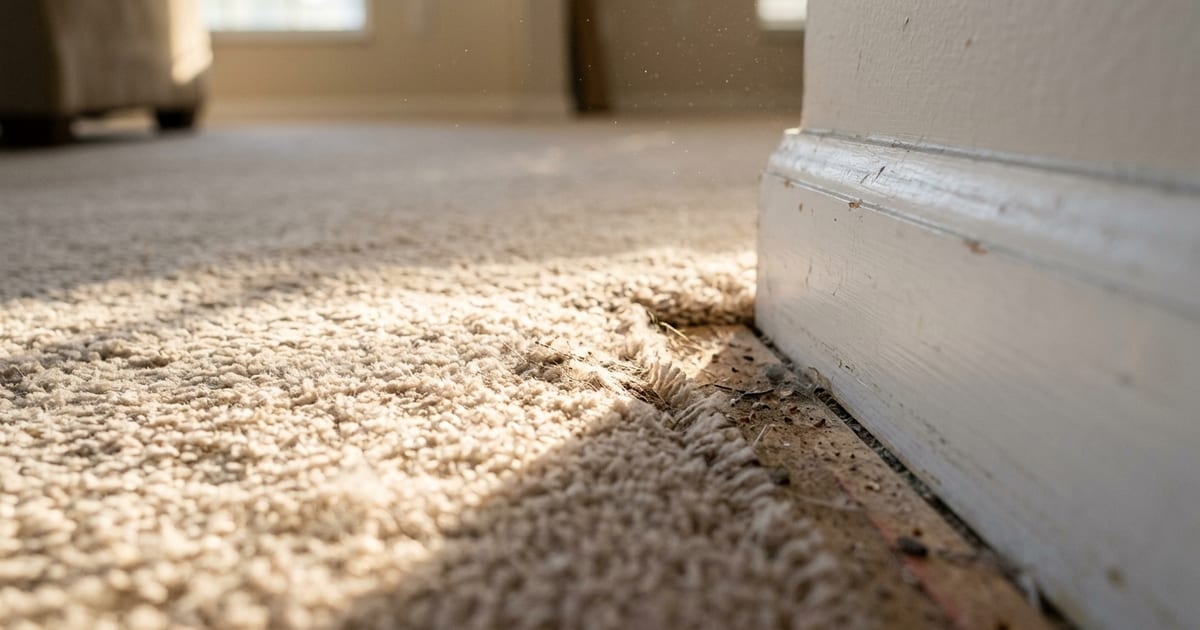
Eggs hatch within a couple of days. The larvae that emerge avoid light, so they work down into carpet fibers, into the gaps between floorboards, under furniture, and into shaded soil and leaf litter outdoors. They feed primarily on dried adult flea feces, the “flea dirt” that falls off the pet along with the eggs, plus other organic debris. The larval stage runs roughly 8 to 15 days.
Then they spin cocoons, and the trouble starts.
The Pupal Window Is Why Treatment Seems to Fail
The cocoon is the flea’s armor, and its patience.
Fleas remain in the pupal stage anywhere from five days to five weeks in the absence of a host, and in cool conditions fully formed adults can stay inside the cocoon for as long as a year. The whole life cycle typically runs 30 to 75 days depending on temperature and humidity, but the pupal stage is the part that stretches.
What brings them out is the arrival of something worth biting. Emergence is triggered by vibration, mechanical pressure, heat, and carbon dioxide, all of which are produced by a person or animal walking past. This is why people returning to a house that has sat empty for a few weeks are sometimes met by a wave of fleas at the door. The population was waiting, and the front door opening was the signal.
Now the part that explains your failed treatment. Laboratory work published in the Journal of Medical Entomology tested insecticides against adult fleas waiting fully formed inside their cocoons and found that pyrethroids and proprietary aerosols failed to kill them. Carpet nap physically shielded the cocoons from several other compounds. And critically, sprays that failed to kill the cocooned fleas still stimulated them to emerge.
The treatment cannot reach the cocoon, but it does tell the flea to hatch. That is why a flea bomb is so often followed by a flea surge a few days later.
After a proper treatment, fleas may continue to emerge for up to two weeks. That is not failure. That is the pupal reservoir draining, and it only works if there is something in place to kill each flea as it comes out.
Does Florida Ever Get a Break From Fleas?
Less than you would think, and more than most people say.
Research on outdoor cat flea survival in north central Florida, published in the entomology literature, found that larvae survived outdoors year round. Survival was best in fall, September through November, reaching as high as 84.6 percent when temperature and humidity were both moderate. The hardest stretch was January through March, when cold fronts pushed larval mortality to between 91.7 and 100 percent and stretched development out to 36 to 50 days.
So the accurate Florida picture is not “fleas are year round” as a flat statement. It is that winter cold fronts genuinely knock outdoor populations down hard, but never eliminate them, and indoor populations are buffered from that entirely by conditioned air. Tampa Bay sits south of Gainesville and runs warmer and more humid, so if anything the winter suppression here is weaker than what that study measured.
Peak adult flea production in Florida lands in August and September, which is exactly the hottest, wettest part of the Tampa Bay year.
The environmental limits are specific: larvae develop between about 13 and 35 degrees Celsius and need relative humidity above 50 percent at minimum, with development best above 75 percent. Larvae are unlikely to survive in direct sun. That combination explains where fleas actually live in a Florida yard, which is not the open lawn but the shaded, humid places: under decks, in dense ground cover, along the north side of the house, and wherever pets and wildlife lie down.
What Fleas Actually Do to a Household
The realistic list for a Tampa Bay household is short, and it is worth stating precisely rather than dramatically.
Tapeworm is the realistic concern. Flea larvae ingest tapeworm eggs, and pets and people become infected by swallowing an infected flea. Children are the most frequently infected people, usually through close contact with a pet. Flea control is the primary prevention.
Cat scratch disease connects to fleas more directly than most people realize. Cats acquire the bacterium mainly through cat fleas, and humans typically get it from a scratch contaminated with flea feces. Controlling fleas on the cat is a primary prevention measure.
Murine typhus exists in Florida but is genuinely rare. UF/IFAS notes only two reported cases in the state over the past decade. It is transmitted through infected flea feces rather than primarily through the bite, and reservoirs include opossums, rats, and free roaming cats. Worth knowing, not worth losing sleep over.
For most Tampa Bay households the real cost of fleas is not disease. It is bites, itching, flea allergy dermatitis in pets, and a population that compounds quietly in the carpet while you treat the animal.
Why the Usual Attempts Do Not Work
Treating the pet only. The pet carries 1 to 5 percent of the population. The eggs, larvae, and pupae are in the carpet, the pet bed, the upholstery, and the shaded yard. Kill every flea on the dog and the environment restocks it.
Treating the house only. The reverse fails for the same reason. An untreated pet is a mobile reintroduction service.
Foggers and flea bombs. Extension guidance is direct that foggers are seldom effective against fleas. Total release aerosols do not provide the coverage or the lasting effect of directed treatment unless they contain an insect growth regulator such as methoprene or pyriproxyfen, and most of the cans sold for this do not. The research above explains why they can actively make the next week worse.
One treatment and done. Given a pupal window that runs weeks, a single application with no residual and no follow up simply misses the fleas that had not hatched yet.
Waiting it out. Pupae can hold for months. There is no waiting them out on a timescale anyone will tolerate.
What Actually Ends a Flea Problem
The mechanism that works is straightforward once you accept the pupal window rather than fighting it.
Treat the pet and the premises in the same window, and keep the pet treated. The logic is worth stating precisely: provided every pet stays treated, the infestation is driven to extinction as developing fleas emerge from the environment, jump on a pet, and die. The pet becomes the trap that empties the reservoir. That only works if the pet’s protection does not lapse in week three.
Use an insect growth regulator, not just an adulticide. IGRs such as methoprene and pyriproxyfen disrupt egg and larval development. They do not kill adult fleas, which is exactly why they are paired with something that does. They provide the long term control of the immature stages that a knockdown spray cannot.
Vacuum, deliberately and often. This is the one homeowner action with outsized effect. Vacuuming kills larvae in carpet, removes adults and eggs, and stimulates the adults waiting inside cocoons to emerge, where treatment can finally reach them. You are not just cleaning, you are pulling the population out of its armor on your schedule instead of its own. Concentrate on where the pet sleeps and rests, since that is where the eggs fell.
Wash the pet bedding and anything else the animal sleeps on, on the same cycle.
Treat the right part of the yard. Not the sunny lawn, where larvae do not survive. The shaded, humid rest areas where pets and wildlife actually lie down.
Expect emergence for about two weeks and plan for it rather than panicking at it.
What This Means If You Have Pets in Tampa Bay
Talk to your veterinarian about keeping pets on flea prevention through the year rather than seasonally. The same walk that picks up fleas picks up ticks, and our Florida tick guide covers why those two need different treatment in the same yard. The Florida survival data is the argument: outdoor larvae persist through every month here, winter only suppresses them, and your indoor environment never gets cold at all.
If fleas keep returning despite doing everything right, the likely explanations are a lapse in the pet’s protection, an untreated animal in the household, a shaded outdoor harborage that never got addressed, or a pupal reservoir that was larger than the first treatment accounted for. Our guide on pest control for pet owners covers working around animals safely.
Liberty Pest Management is family owned, based in Odessa, and has served Tampa Bay since 2007 under Florida license JB-151032. If the fleas came back two weeks after you thought you were done, ask us for a free quote and we will treat the stage you cannot see.
Liberty Pest Management serves the Tampa Bay area including Pasco, Hillsborough, and Pinellas counties, from Odessa and Land O’ Lakes to Tampa, Brandon, and Clearwater. Licensed by the Florida Department of Agriculture (JB-151032). Call us at 813-961-2627 or get a free quote today.