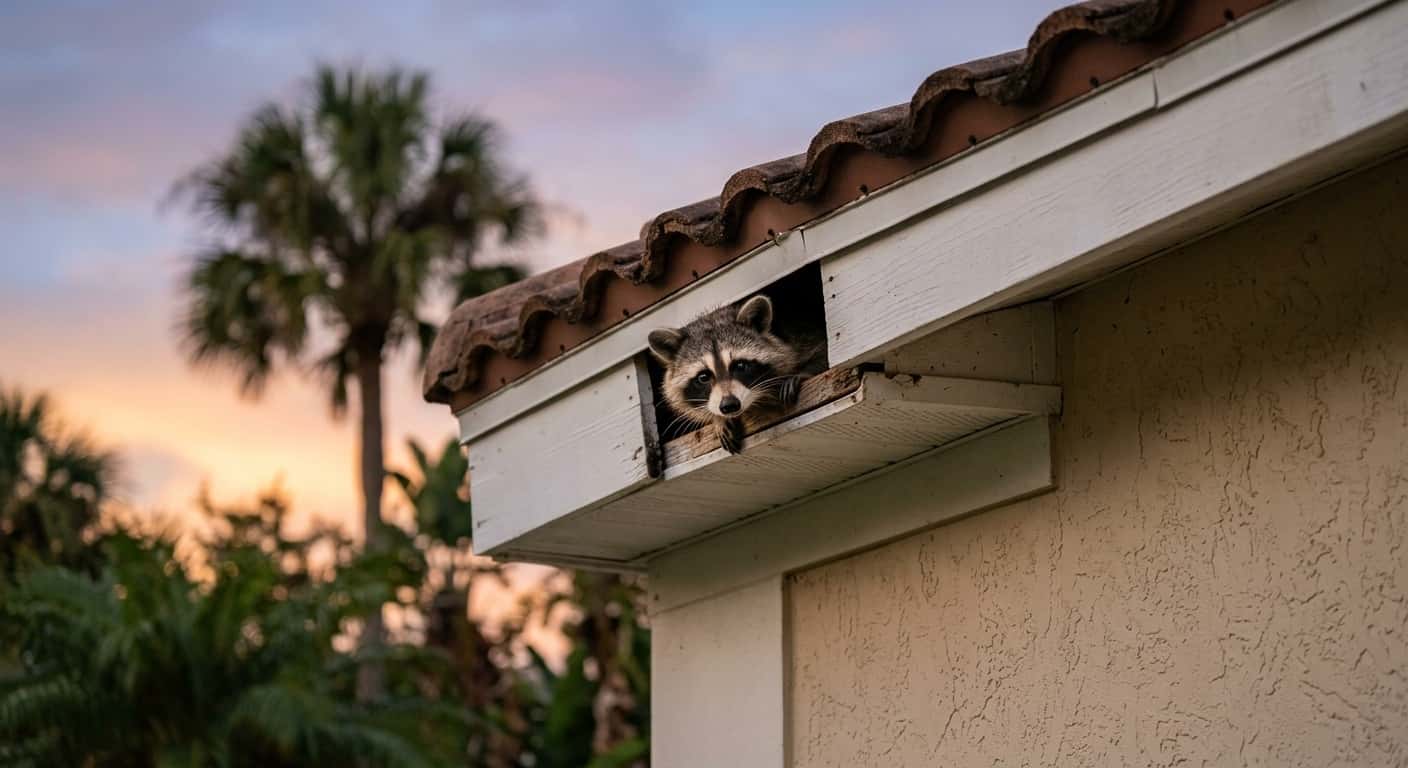
Squirrels, raccoons, bats, armadillos, and opossums are the animals we’re most often called out to remove from Tampa Bay homes. They don’t just make noise overhead. They shred insulation, chew wiring, contaminate attics, and open up entry points that let in weather and every pest behind them.
Florida also regulates this more tightly than most homeowners expect. There are rules about which animals you may remove, during what months, and what you’re allowed to do with one once it’s in a trap, and getting that wrong carries a fine. Below, we cover each common intruder, the damage it causes, what the law says, and how to get it out safely and legally.
Key Takeaways
- Squirrels, raccoons, bats, armadillos, and opossums are the most common wildlife intruders in Tampa Bay homes
- Complete wildlife removal includes trapping, exclusion, and cleanup. Early intervention significantly reduces costs
- Bat maternity season runs April 16 through August 14, and excluding bats during it is illegal without a state permit. April 15 is the last legal day to act, and August 15 is the first
- Florida law allows homeowners to remove raccoons, opossums, and armadillos without a permit if they’re causing property damage
Which Animals Are Most Likely to Invade Your Tampa Bay Home?
Five animals account for most wildlife calls here, and each one goes after a different part of the house. Squirrels and raccoons take the attic, bats take wall voids and chimneys, opossums take crawl spaces and porches, and armadillos never come inside at all, they wreck the yard. Knowing which one you have determines both the removal method and what the law lets you do.
Squirrels
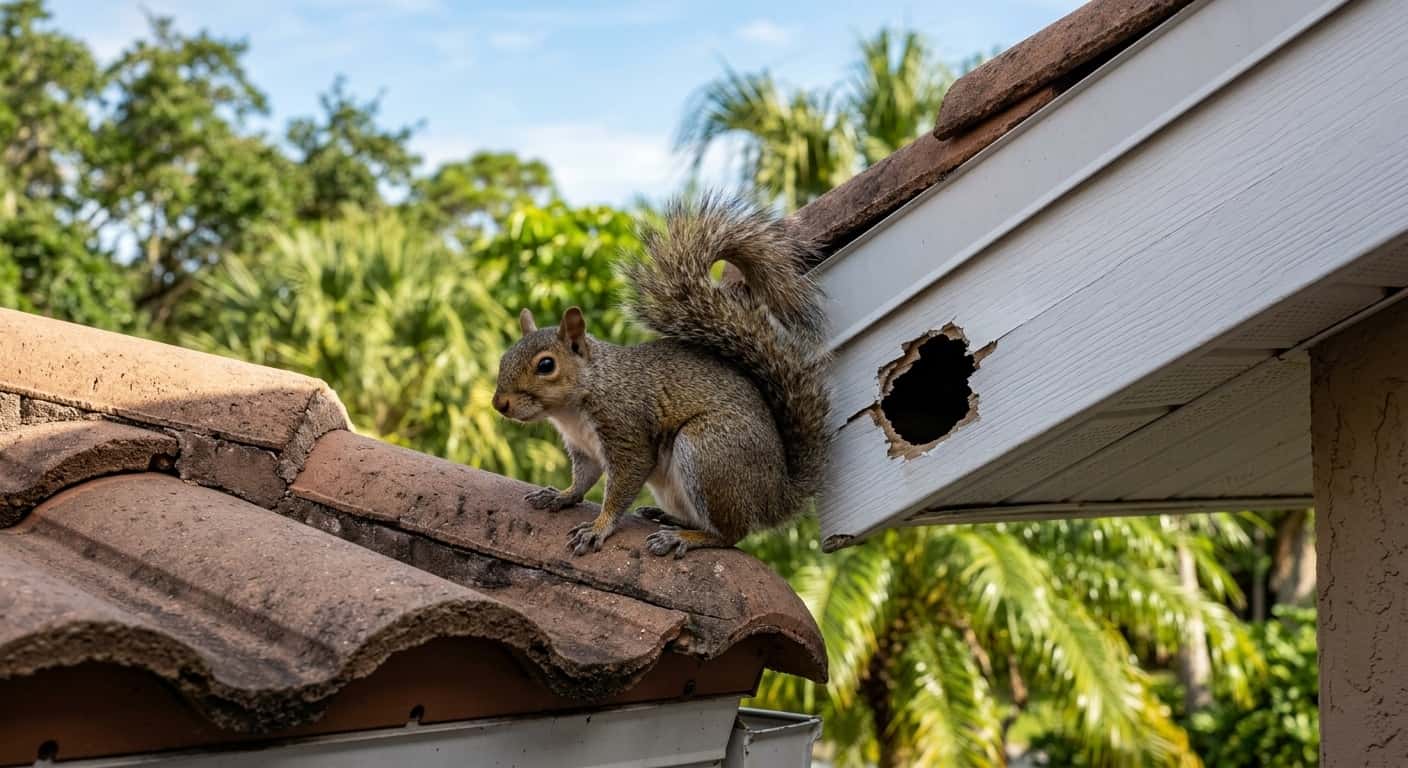
Squirrels are the most common attic intruder after roof rats in Tampa Bay. Eastern gray squirrels and fox squirrels both thrive in our neighborhoods, and they access attics through the same routes as roof rats, overhanging tree branches, utility lines, and gaps in soffits or roof vents.
Damage they cause
- Chew through electrical wiring (same fire hazard as roof rats)
- Shred insulation to build nests
- Gnaw holes in soffits, fascia, and roof decking to create or widen entry points
- Store food caches that attract insects
Signs of squirrels vs. rats differ mainly by time of day. Squirrels are active during daylight hours. If you hear running and scratching in your attic during the morning and late afternoon, it’s likely squirrels. If the noise happens at night, think roof rats.
Raccoons
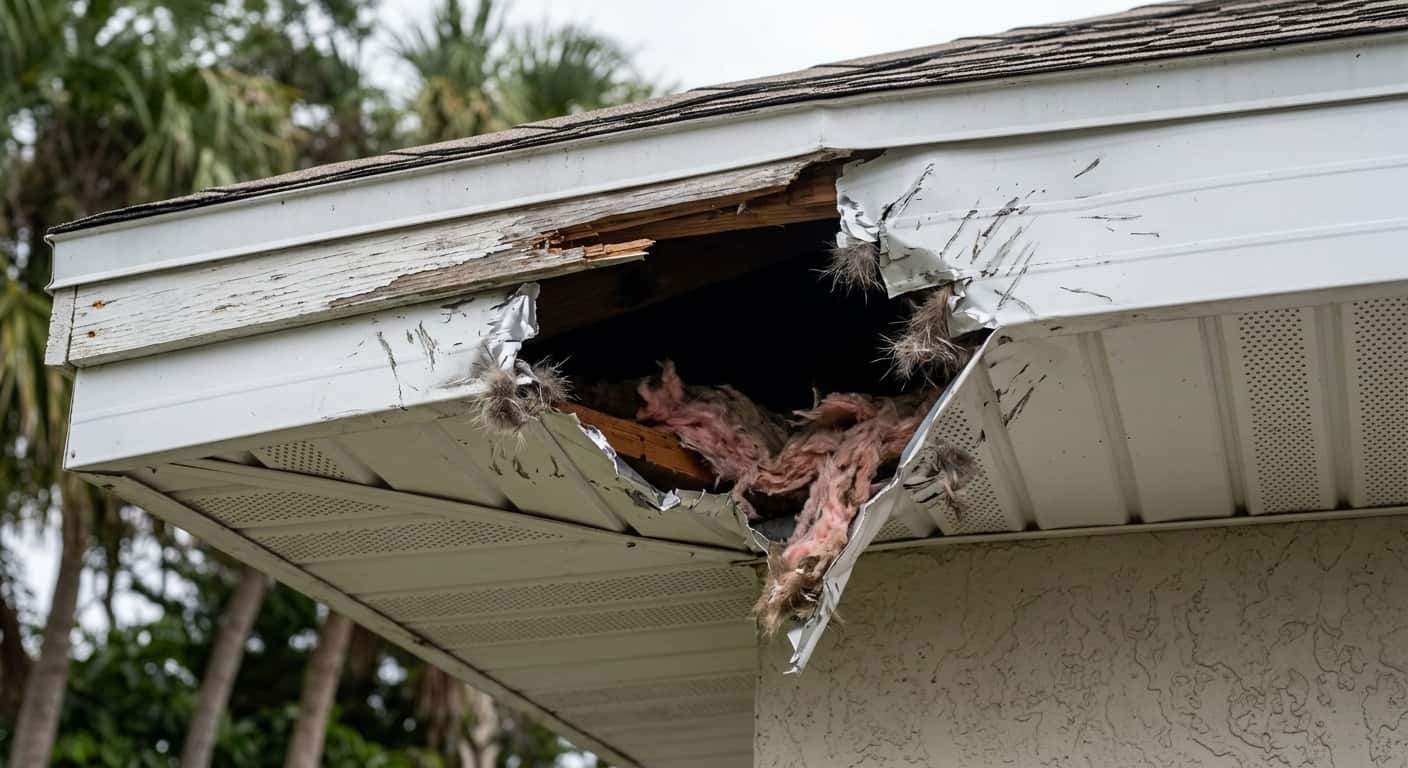
Raccoons are stronger and more destructive than any other common home invader. They can tear open soffit panels, rip off vent covers, and peel back roof shingles with their hands to access attic spaces. A mother raccoon looking for a nesting site can create significant structural damage in a single night.
Damage they cause
- Ruin insulation with urine and feces. A raccoon family produces enough waste to soak through insulation into the ceiling below, staining drywall and leaving an odor that outlasts the animals
- Create large entry holes that expose your attic to weather and additional pests
- Damage HVAC ductwork and stored belongings
- Bring fleas, ticks, mites, and lice into your home
Disease risks start with raccoon droppings, which spread raccoon roundworm (Baylisascaris procyonis), a parasite that can cause serious neurological damage in humans. Raccoons also carry rabies, leptospirosis, giardiasis, and salmonellosis.
According to the Florida Fish and Wildlife Conservation Commission, homeowners may remove raccoons, opossums, and armadillos causing property damage without a permit, but the animal must be humanely euthanized or released on site. Florida law prohibits relocating captured wildlife to another area. This means trapping an animal alive yourself often creates a legal problem. You can’t just drive a raccoon to a park and release it.
Bats
Bats are one of the most common animals in Florida to carry rabies, according to the FWC. They roost in attics, wall voids, and chimneys, entering through gaps as small as 3/8 of an inch. A single colony can number in the dozens or hundreds.
Damage they cause
- Accumulated bat guano (droppings) creates foul odors, stains ceilings, and degrades insulation
- Guano harbors Histoplasma capsulatum, a fungus that causes histoplasmosis, a potentially serious respiratory infection
- Urine saturates wood framing and drywall over time
A critical legal restriction applies to bats. Florida’s bat maternity season runs April 16 through August 14, and excluding bats during it is illegal without a state permit. Pups can’t fly yet, so sealing the roost traps them inside to die. In practical terms, April 15 is the last day you can legally exclude, and August 15 is the first day you can start again. If you find bats in May, you are waiting until August, and that is worth knowing before anyone gets on a ladder.
Removal here means exclusion, with devices at every entry point that let bats out but not back in, and it can only be done during the legal window (mid-August through mid-April).
Armadillos
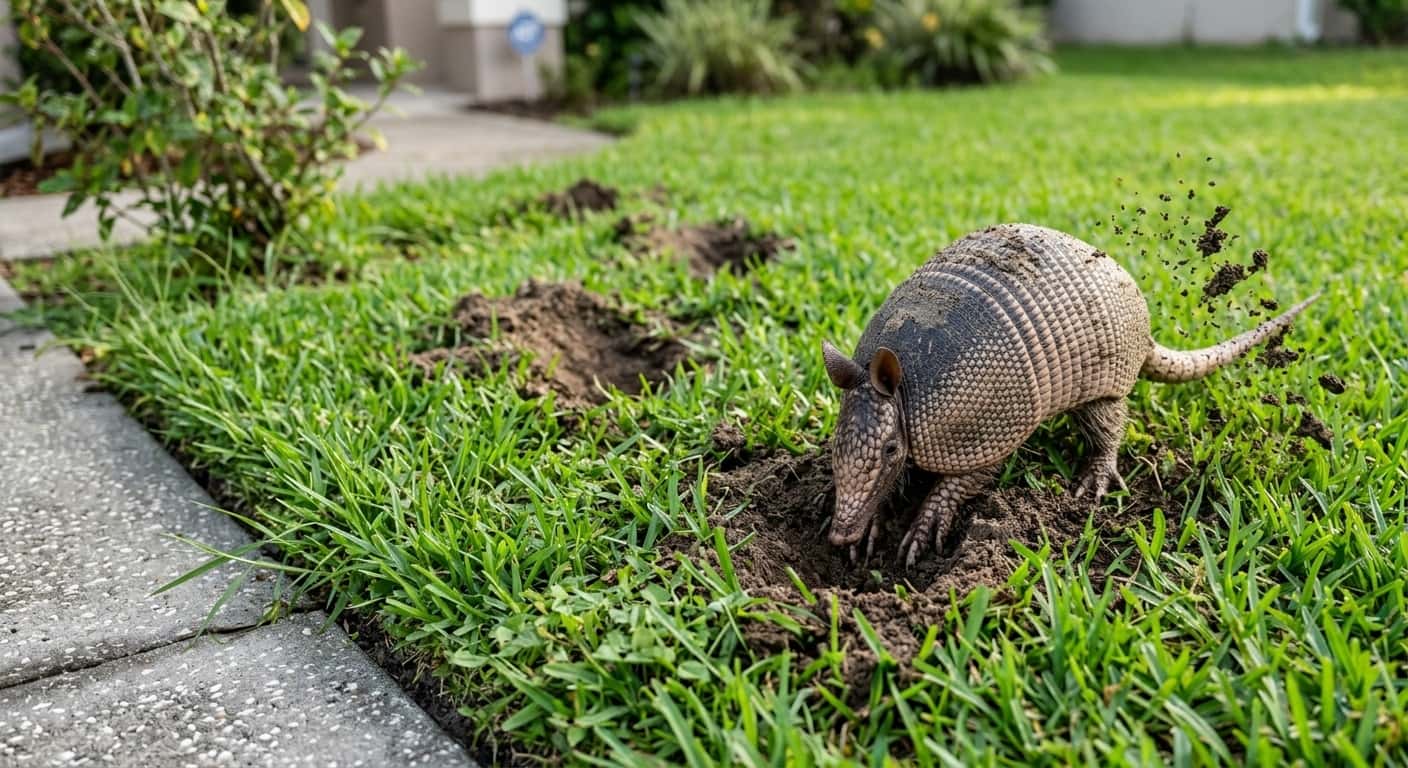
Armadillos don’t invade your attic. They destroy your yard. Nine-banded armadillos dig extensively while foraging for grubs and insects, leaving a trail of uprooted plants, torn up lawns, and excavated flower beds. Their burrows near foundations, patios, and driveways can undermine structural supports and cause cracking or uneven settling.
Signs of armadillo activity
- Holes shaped like cones, 3-5 inches deep, scattered across your lawn
- Uprooted plants and disturbed mulch beds
- Burrow entrances (7-10 inches in diameter) near foundations, under porches, or along fence lines
Opossums
Opossums are Florida’s only marsupial. They seek shelter in attics, crawl spaces, garages, and under porches. While they’re generally less destructive than raccoons, they leave big messes, scattering garbage, leaving droppings, and occasionally dying in wall voids or crawl spaces (creating a severe odor problem).
Disease risks with opossums include tuberculosis, spotted fever, and multiple parasites. Despite the common myth, opossums can carry rabies, though they’re less likely to than raccoons due to their lower body temperature.
If nighttime scratching is your main concern, it may be roof rats rather than wildlife. See our detailed guide on roof rats in your Florida attic for identification tips and removal steps.
What Does Florida Law Say About Wildlife Removal?
Florida wildlife removal is regulated by the Florida Fish and Wildlife Conservation Commission (FWC), and the rules are more specific than most homeowners realize. Ignoring them can result in fines.
Under Florida law, any property owner may remove nuisance wildlife that causes or is about to cause property damage, presents a threat to public safety, or causes an annoyance within a building on their property. However, all traps must be inspected at least once every 24 hours, and animals captured alive must be released on site or humanely euthanized within 24 hours. Relocation is prohibited.
What You Can Do Without a Permit
- Remove raccoons, opossums, and armadillos causing property damage on your land
- Use live traps or snares (must check traps every 24 hours)
- Release a captured native animal on the same contiguous property where it was caught, or humanely euthanize it, either way within 24 hours of capture
While the law allows homeowners to handle certain situations, professional wildlife removal is strongly recommended. Improper trapping can injure the animal or the homeowner, and the rule against relocation creates complications most people don’t anticipate until they have an animal in a cage with no legal way to move it. A licensed professional handles the entire process safely, legally, and humanely.
What Requires a Permit or Professional
- Protected species. Any endangered, threatened, or special concern species listed by the state needs an FWC permit for removal
- Bats. Exclusion only, never trapping or killing, and only in the legal window from August 15 through April 15
- Commercial wildlife removal. Anyone removing wildlife for compensation must hold FWC Wildlife Management Personnel Certification
- Firearms. Can only be used during daylight hours for nuisance wildlife removal
The Relocation Problem
Here’s where most DIY attempts go wrong, and it’s worth understanding before you buy a trap rather than after. A homeowner catches a raccoon, loads the cage into the truck, and only then discovers there’s nowhere legal to take it. Release on the property where it was caught, or humane euthanasia, are the only options Florida allows. Driving it to a park across town is not a loophole, it’s a violation.
That single rule is what makes DIY trapping impractical for anything larger than a squirrel. Trapping is the easy part. Having a lawful, humane plan for the animal afterward is the part that stops people, and it’s the reason most of these jobs end with a call to someone licensed.
If you’re unsure whether your situation calls for a professional, our guide on when to call an exterminator covers the key warning signs for all pest types.
What Are the Signs of Wildlife in Your Home?
Wildlife invaders are larger and noisier than insects, but homeowners still miss the early signs. Catching a problem within the first week limits the damage. Watch for these signs.
Sounds
| Time of Day | Likely Animal |
|---|---|
| Morning and late afternoon | Squirrels |
| Dusk and nighttime | Raccoons, opossums, bats |
| All night (running/scratching) | Roof rats |
| Evening (fluttering/chirping) | Bats |
Visual Evidence
- Droppings. Raccoon droppings are large (2-3 inches), tubular, and often found in a communal “latrine” spot. Bat guano is small, dark, and accumulates in piles below roosting areas. Squirrel droppings resemble small, dark pellets.
- Damage to exterior. Torn soffit panels, gnawed vent screens, lifted shingles, and scratched or chewed fascia boards
- Grease marks or fur. Raccoons and squirrels leave oily residue and fur around entry holes
- Odor. Strong urine smell from the attic suggests raccoons or a large bat colony. A rotten smell usually indicates a dead animal in a wall void or crawl space.
Yard Evidence
- Holes shaped like cones in the lawn (armadillos)
- Overturned garbage cans with scattered contents (raccoons)
- Burrow entrances near foundations (armadillos, rats)
- Disturbed garden beds and uprooted plants (armadillos, squirrels)
How Do You Prevent Wildlife From Entering Your Home?
Prevention costs far less than removal, because removal is never just removal. It’s trapping, then sealing every entry point, then cleaning contaminated insulation, and often replacing it. An afternoon spent on hardware cloth and tree trimming avoids all of that.
Seal Your Roofline
- Inspect and repair soffit panels, secure any that are loose, warped, or damaged
- Cover all attic vents and gable vents with hardware cloth in a heavy gauge (not plastic screening, raccoons tear through plastic)
- Seal gaps around plumbing vent pipes and electrical penetrations with metal flashing
- Replace damaged or missing shingles and confirm ridge vents are properly sealed
- Install chimney caps if you have a fireplace
Manage Your Landscaping
- Trim tree branches to at least 4 feet from your roofline. Squirrels and raccoons jump farther than you’d think
- Remove dense ground cover near your foundation that provides hiding spots for armadillos and opossums
- Pick up fallen fruit from citrus and palm trees. Fruit is a primary attractant for raccoons and squirrels
- Keep your lawn mowed short to discourage armadillo foraging (they prefer areas where they can dig easily in soft, irrigated soil)
Secure Food Sources
- Use garbage bins with locking lids that animals can’t open. Raccoons are strong enough to flip standard lids
- Bring pet food bowls inside at night
- Clean up around bird feeders or remove them entirely if you have active wildlife issues
- Secure compost bins with tight lids and hardware cloth bottoms
- Don’t leave grills uncleaned overnight
Structural Maintenance
- Inspect your roof, soffits, and fascia after every storm season. Wind damage creates new entry points
- Check crawl space vents and access panels for gaps
- Check that garage doors seal completely when closed
- Repair any foundation cracks or gaps around utility penetrations
For a guide to keeping your home sealed tight in every season, see our guide on how to seal your home against pests each season.
When Should You Call a Wildlife Professional?
Trimming trees, securing garbage, and screening vents keeps wildlife from settling in. Once an animal is already living in your home, though, the calculation changes, and the reasons are practical rather than promotional.
Call a professional when any of these apply.
- You hear consistent sounds from the attic, walls, or crawl space. An animal has established residence.
- You find large droppings, urine staining, or strong odors. Contamination calls for professional cleanup.
- You see structural damage to soffits, vents, or roofing. Repairs must be coordinated with exclusion.
- You suspect bats. Legal restrictions on timing and method demand expertise.
- You’ve trapped an animal and don’t know how to proceed legally. Florida’s ban on relocation creates complications for DIY trappers.
- A raccoon is involved. Rabies risk makes handling dangerous without proper equipment.
What professional removal includes
- Inspection. Identify the species, locate all entry points, and assess damage
- Removal/trapping. Removal methods appropriate to the species
- Exclusion. Seal all current and potential entry points
- Sanitation. Clean and disinfect contaminated areas
- Repair. Fix structural damage and replace contaminated insulation (varies widely)
In Florida, verify that your wildlife removal provider holds FWC Wildlife Management Personnel Certification. This license involves passing an examination covering species identification, trapping methods, and state regulations. Pest control companies like Liberty Pest Management that also handle wildlife are licensed through both FWC and the Florida Department of Agriculture.
Visit our services page to learn more about Liberty Pest Management’s wildlife removal and pest control offerings.
Frequently Asked Questions
Can I trap and relocate a raccoon in Florida?
No. Florida law prohibits relocating captured wildlife to another area. Under FWC regulations, nuisance animals captured alive must be released on the property where they were caught or humanely euthanized within 24 hours. This rule applies to raccoons, opossums, armadillos, and all other nuisance wildlife. It’s the primary reason most homeowners hire licensed professionals.
When can bats be removed from a Florida home?
Bat exclusion is legal in Florida from August 15 through April 15. During maternity season, April 16 through August 14, it is prohibited without a state permit, because flightless pups would be trapped inside. Bats cannot be killed or trapped. Exclusion devices that let them leave but not get back in are the only legal method. If you discover bats during the restricted period, a professional can assess the situation and plan exclusion for the legal window.
How much does wildlife removal cost in Tampa Bay?
Wildlife removal costs vary significantly by species, the number of animals involved, the extent of damage, and the exclusion work required. Raccoons cost more due to rabies handling protocols. Bat colony exclusion requires specialized devices that let bats out but not back in at every entry point. Most jobs include trapping, entry point sealing, sanitization, and sometimes insulation replacement. Contact Liberty Pest Management for a free quote on the work your situation actually needs.
Are armadillos destructive to Florida homes?
Armadillos primarily damage yards and landscaping rather than structures. Their digging leaves holes shaped like cones across lawns and uproots plants and mulch. The bigger structural concern is their burrows, when dug near foundations, patios, or driveways, armadillo burrows can loosen soil and cause cracking or uneven settling over time. They can be removed without a permit if they’re causing property damage.
What’s the difference between squirrels and rats in my attic?
The easiest distinction is timing. Squirrels are active during daylight hours, you’ll hear them in the morning and late afternoon. Roof rats are nocturnal and active from dusk through dawn. Squirrel droppings are small, round pellets. Rat droppings are shaped like spindles with pointed ends. Squirrel damage tends to be focused around entry points (gnawed holes in soffits), while rats leave grease marks along travel paths and chew on wiring throughout the attic.
For a comprehensive look at roof rat behavior and removal, read our guide on roof rats in your Florida attic.
Protect Your Home From Tampa Bay’s Wildlife
Living alongside wildlife is part of Florida life. Keeping it outside your home is a matter of sealing entry points, managing your landscaping, and acting quickly when you notice signs of intrusion. The longer an animal stays, the more damage it causes and the more expensive removal becomes.
Your wildlife prevention checklist
- Inspect soffits, vents, and roofline for gaps or damage
- Trim trees at least 4 feet from your roof
- Install hardware cloth in a heavy gauge over all attic vents
- Secure garbage bins with locking lids
- Pick up fallen fruit daily
- Check for yard damage (armadillo holes, burrow entrances)
- Schedule a professional inspection if you hear sounds or see damage
Remember that Florida law limits what you can do on your own. When in doubt, call Liberty Pest Management. We understand FWC regulations and handle removal safely, legally, and humanely.
Request a free quote from Liberty Pest Management to assess your wildlife situation.
Liberty Pest Management serves the Tampa Bay area including Pasco, Hillsborough, and Pinellas counties, from Odessa and Land O’ Lakes to Tampa, Brandon, and Clearwater. Licensed by the Florida Department of Agriculture (JB-151032). Call us at 813-961-2627 or get a free quote today.