In spring and fall, Tampa Bay homeowners suddenly see winged insects around windows and doors. Two very different pests swarm this way, ants and termites, and telling them apart decides what you do next. One is a nuisance. The other can eat your house.
What Are Swarmers?
Swarmers are the winged, reproductive members of a colony. They leave in a group to mate and start colonies of their own, which is why they show up all at once, usually on a warm, humid day in spring or fall. Seeing them means a mature colony is nearby, either ants in a wall void or soil, or termites in the ground or wood. The good news is that the two are easy to tell apart once you know the three things to look at.
How to Tell Them Apart
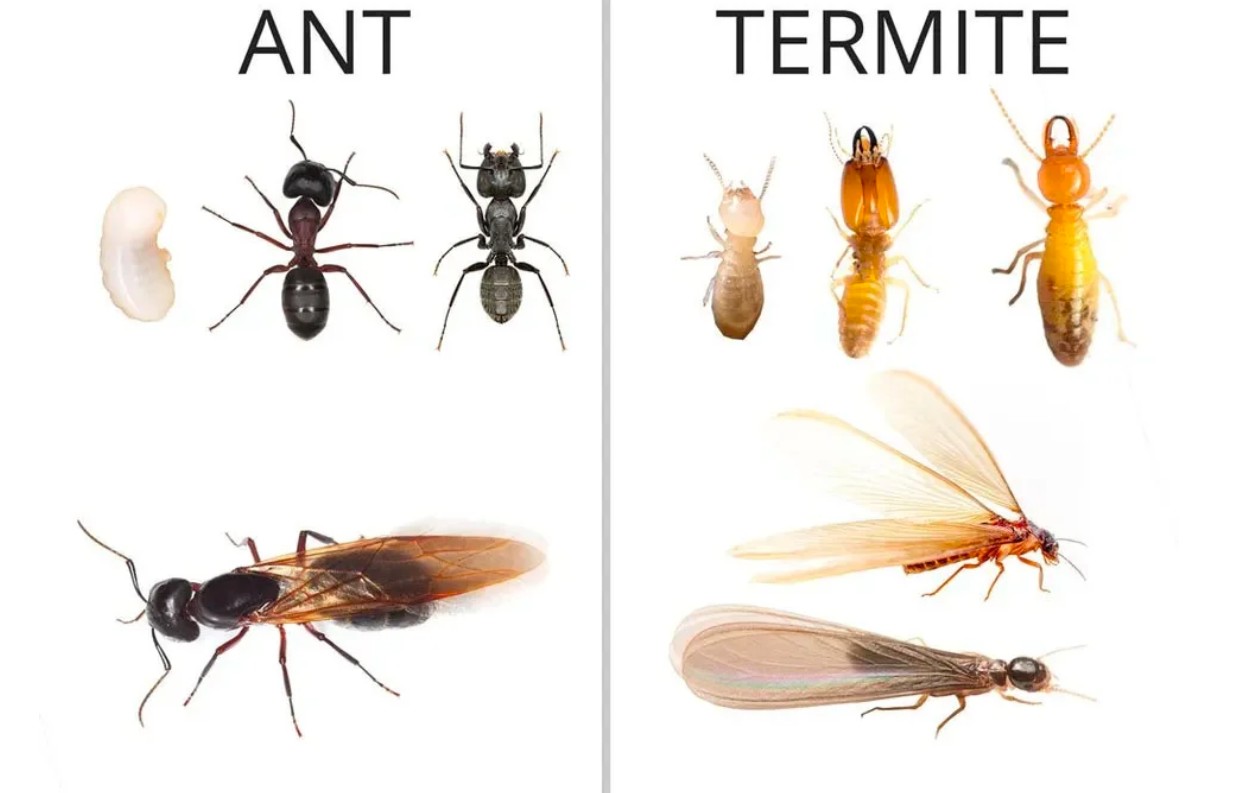
Get a close look at one insect, ideally against a light background, and check the waist, the wings, and the antennae.
The waist. This is the quickest tell. An ant has a pinched, hourglass waist between its midsection and abdomen. A termite has no waist at all. Its body is a straight, uniform tube from front to back.
The wings. An ant’s two pairs of wings are different sizes, with the front pair noticeably longer than the back. A termite’s four wings are all the same length, all roughly as long as its body, and they fall off easily. A pile of discarded, equal-length wings on a windowsill is a classic termite sign.
The antennae. Ant antennae are bent, with a distinct elbow. Termite antennae are straight and look like a tiny string of beads.
Color helps less than people think. Ants range from dark brown or black to reddish, while termites tend to be pale to light brown, but lighting and species vary enough that color alone won’t settle it. Trust the waist and wings.
What the Behavior Tells You
How the insects behave points you toward the nest. Ant swarms are usually smaller and scattered, and they gather around windows, doors, and cracks as they leave a colony in the walls, attic, or nearby soil. Once they mate, the ants drop their wings and move on to nest.
Termite swarms are bigger, sometimes thousands at once, and they cluster toward light. Because termites keep their wings longer than ants do, they linger and draw attention. A large indoor swarm near a window is the sign that most often sends a homeowner looking for answers, and it usually means a colony is already established in or under the structure.
Which One Damages Your Home?
This is why the identification matters. Swarming ants themselves do little structural harm. Carpenter ants, the exception, nest in wood, but Florida’s carpenter ants tend to move into wood that is already damp or damaged rather than carving through sound lumber the way their northern cousins do. A carpenter ant nest is a signal to find and fix a moisture problem.
Termites are the real threat to the structure. They feed on wood from the inside, quietly, and an untreated colony can do serious damage over time. If your swarmers are termites, the wood in your home is potentially on the menu, and that changes how fast you need to act.
What Should You Do?
- Identify what you have. Use the waist, wings, and antennae to decide ants or termites. Save a few of the insects or their shed wings in a bag or on tape. It makes confirmation easy.
- Look for supporting signs. For termites, check for mud tubes on the foundation and hollow-sounding or soft wood. For ants, look for trails and nesting near walls, baseboards, and damp wood.
- Get it confirmed. If you suspect termites, contact Liberty Pest Management and we’ll confirm the identification, then refer you to a licensed termite specialist, since we don’t treat termites ourselves. If it’s ants, our ant control service handles the colony, seals the entry points, and removes what’s drawing them in.
Ant and termite swarmers look alike at a glance, but the waist, wings, and antennae tell you which one you have. Catch it early either way. If you’re not sure what’s flying around your home, contact Liberty Pest Management and we’ll identify it, then treat the ants or refer you out for termites.